
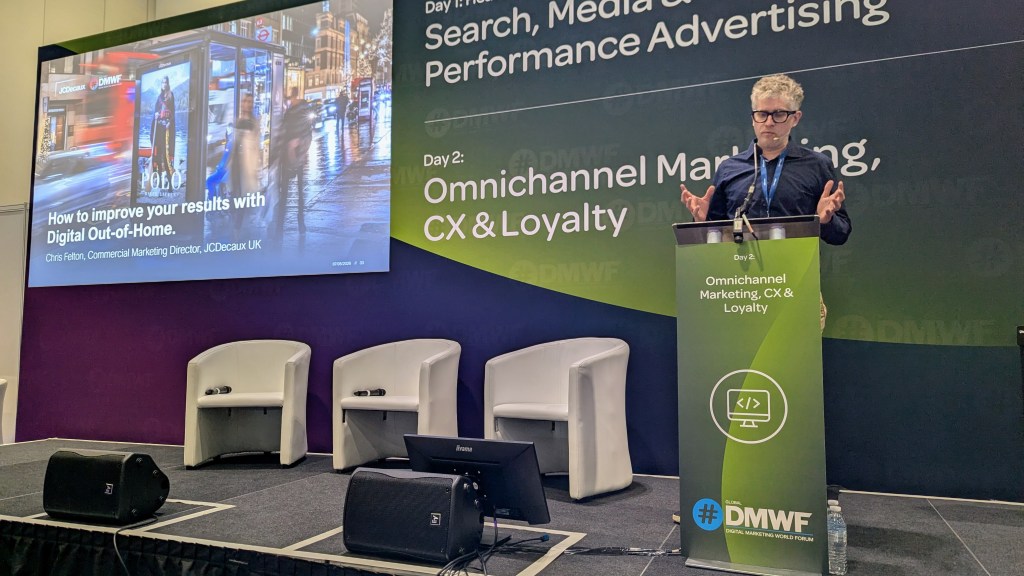
This article is a summary of my notes from the ‘How to Improve Your Results with Digital Out of Home‘ session at Digital Marketing World Forum 2026. The presenter was Chris Felton. Director of Commercial Marketing, JCDecaux. I’ve used AI to turn my notes into a short summary that’s in line with my writing style.
Last‑click attribution has made digital advertising comforting. It’s measurable, defensible, and easy to optimise. It’s also taught us to overvalue what can be clicked and undervalue what’s actually noticed.
Two thirds of people skip online ads. Gen Z skip almost everything. Many block ads entirely. Add AI search summaries are quietly killing clicks, and the open web is becoming a hostile place for attention.
Out‑of‑home works differently.
When people leave the house, their mindset changes. Government research suggests 81% of us feel happier outdoors. We’re more open, more attentive, and — crucially — more receptive. You can’t skip a billboard, but people don’t resent it either: around two thirds remember the ads they see, and 84% of Gen Z say they actively pay attention to OOH.
There’s a trust effect too. Brands advertising out of home are trusted more than those that aren’t. Small percentages, big long‑term impact.
Most interestingly, OOH doesn’t compete with digital — it feeds it. Seeing outdoor media increases online search, and searches made outdoors convert better. Mobile searches triggered out of home are more likely to end in store visits and purchases. Used well, OOH is a primer: combine it with mobile and brand recall doubles.
Measurement has finally caught up. Location data, sales matching, footfall, econometric modelling — this is no longer the unaccountable medium it once was. The problem isn’t measurability. It’s narrow thinking.
People still leave the house. Their mood shifts. Their attention behaves differently. Screens don’t stop mattering — context does.
You can skip an online ad. You can’t skip a street corner.
And that’s not a disadvantage.

 Glyphs & Graphs