
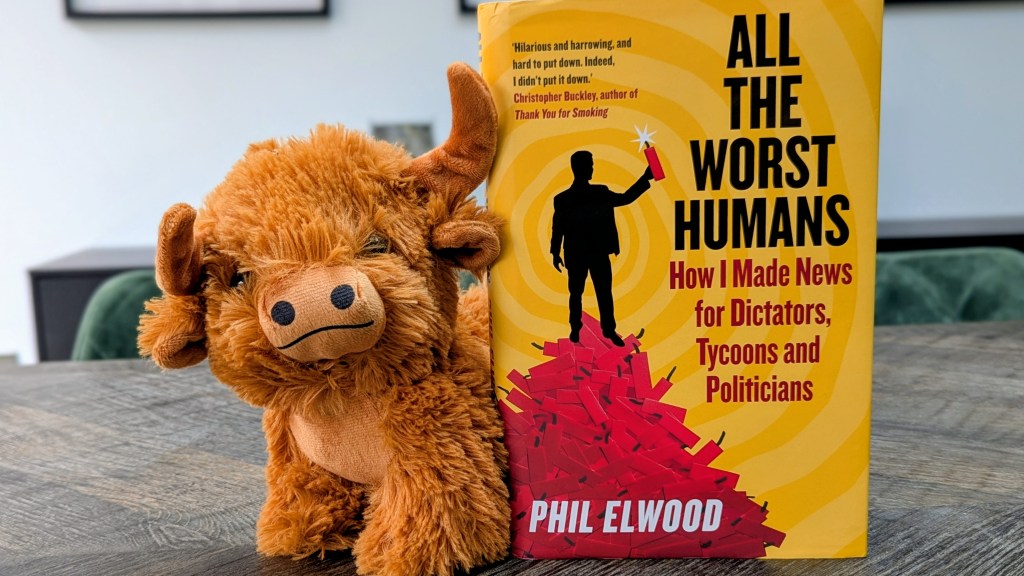
If you’re looking for a book to remind you how dull your job is, this is it.
Read more: All The Worst Humans: How I Made News for Dictators, Tycoons and Politicians by Phil ElwoodElwood has had quite the career in public relations. I won’t spoil with names, but I’m sure you can paint a picture from the title of the kind of people we’re talking about here.
This book did three things for me. It taught me something about how PR works, it reinforced preconceptions I had about the moral grounding of people who work in PR, and it told a really good human story about a man navigating work and relationships while struggling with his conscience and his mental health.
So, here are some things this book taught me about PR:
1. Creating narratives with archetypes
Elwood says PR people simplify complex events into emotionally compelling stories.
“Every story has three parts: a villain, a victim, and a vindicator.”
He explains that crisis PR is often about rapidly reframing the client:
“In the PR business, we try to convert a villain into a vindicator or a victim as fast as possible.”
2. Using mainstream media as the real persuasion engine
One of Elwood’s central arguments is that PR operatives don’t persuade the public directly – they persuade journalists and editors.
“My job isn’t to manipulate public opinion. My job is to get gatekeepers like CNN to do it for me.”
“Once you have ink, your story becomes real.”
This is one of the book’s major themes: legitimacy comes from media amplification, not necessarily truth.
3. Manufacturing “earned media”
Elwood repeatedly says the most valuable PR outcome is not advertising or op-eds, but getting journalists to repeat your framing independently.
“The goal of PR, the brass ring, is to get ‘earned media,’ to get a reporter to say the right thing about you.”
He contrasts this with self-published messaging because audiences trust journalists more than direct corporate communication.
4. Independent journalism isn’t free from malicious influence
He portrays the press/PR relationship as symbiotic and transactional.
“The best journalists in the world aren’t always breaking stories because of their dogged reporting skills; they’re breaking them because they rely on people like me to feed them exclusive scoops.”
A recurring tactic in the book is selectively leaking information to shape coverage before competitors or critics can respond.
5. ‘Astroturfing’ fake grassroots campaigns
One of the most controversial examples described in reviews of the book involves Qatar’s World Cup bid. According to Elwood, operatives created a fake grassroots campaign to undermine the U.S. bid.
The Guardian review summarizes how a shell nonprofit was used to create the appearance of authentic public opposition:
“The Healthy Kids Coalition … looked like a parental campaign group, but in fact was just a shell.”
This is classic “astroturfing”: simulated grassroots activism.
6. Reputation laundering
Elwood openly describes PR as reputation laundering.
“Operators like me oil the machines that prop up authoritarian power all over the world.”
And:
“I help those machines function by laundering the sins of dictators through the press.”
The book discusses efforts involving Libya, Syria, Qatar, and others.
7. Repetition and invasive messaging
Elwood describes effective PR narratives as psychologically sticky.
“Truly effective narratives become invasive thoughts we plant in the public’s mind.”
The idea is that repetition and emotional framing can make narratives feel naturally true over time.
8. Exploiting weak points and pressure campaigns
He also discusses aggressive media tactics:
“When you’re trying to apply pressure through the press, you must know and exploit your enemies’ weak spots.”
This includes targeted leaks, reputational attacks, and coordinated pressure through coverage cycles.
9. Reframing crises rather than solving them
A recurring cynical theme is that PR often substitutes communication for accountability.
The Guardian quotes Elwood saying:
“If my client lights their house on fire, you can be damn sure I’ll get the press to blame outdated fire codes.”
PR is often about redirecting blame rather than addressing wrongdoing.
10. If the bomb must go off, better it were controlled
Detonating a bomb in a safe location is a PR trick of last resort. If you know you are about to be punched in the face, would you rather have Mike Tyson do it or some guy named “Mike” from accounting?
He’s talking about how stories break. If a negative story is going to drop, better to leak it to a ‘tier-two’ publication before the ‘tier-ones’ catch up.
It’s all a bit depressing really, isn’t it?
Book club model: Yusuf

 Glyphs & Graphs