
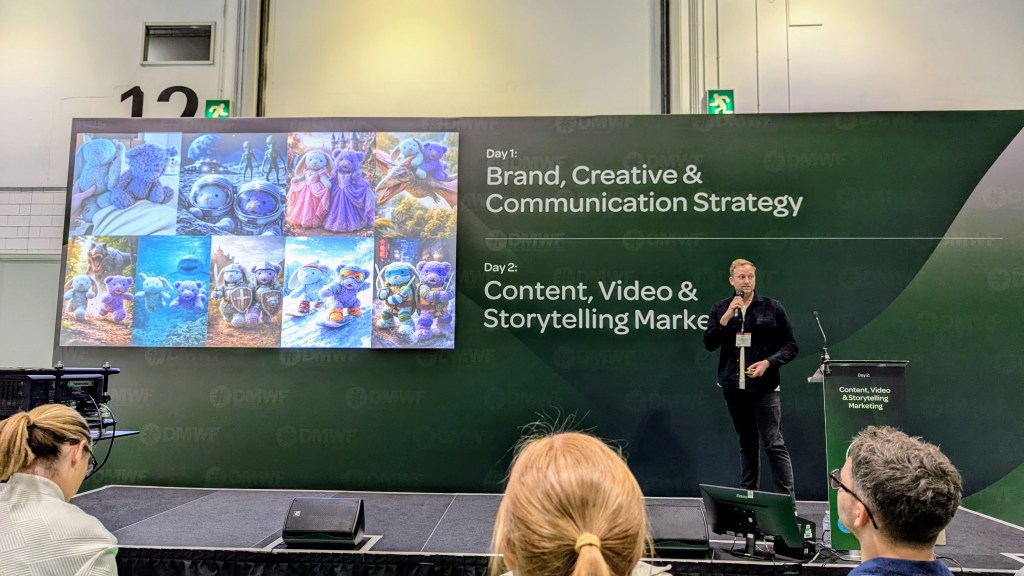
This article is a summary of my notes from the ‘Why Your Product Needs a Narrative‘ session at Digital Marketing World Forum 2026. The presenter was Elliot Rayner, Head of Storytelling, OWOW. I’ve used AI to turn my notes into a short summary that’s in line with my writing style.
We’re heading into what Elliot Rayner, Head of Storytelling at OWOW, called the year of the storyteller. Not as a nice‑to‑have — but as a core marketing skill. Storytelling now has job titles, teams, and budget.
And there’s a reason for that.
As AI eats tasks, we’re forced to redefine our value. Storytelling is one of the few things it can’t do for you — only with you. Used well, AI isn’t the storyteller. It’s the torch.
Great stories aren’t fluffy. They’re grounded in structure and science. Aristotle nailed it centuries ago: logic, credibility, emotion. Miss one and the story collapses. And if you want the modern science behind that, Emily Falk’s What We Value is a good place to start.
A useful distinction from the session:
- Emotions are often unconscious bodily responses.
- Feelings are our conscious experience of them.
And almost all of them work. The more people feel, the more they buy.
So how do we invoke emotion?
The strongest narratives engage the senses:
- Sight focuses attention.
- Sound is wildly underrated — brand recall is often stronger through audio than visuals.
- Smell triggers emotion and value (there’s a reason luxury leather goods are scented).
- Weight signals quality.
- Taste drives decisions before we even notice we’ve made them.
None of this is accidental.
The important point: the product barely matters. If you understand the science, the same frameworks work everywhere.
The process is simple, but not easy:
Answer one
Product
What value does it actually create?
Answer one
Audience
Who cares about that value the most?
Answer one
Market
How do you make that value believable?
- Product: what value does it actually create?
How can you just communicate the value the product creates. Spend time learning about the product. Spend time communicating the value. Spend less time communicating the product. Complex products - Audience: who cares about that value most?
There is a certain group of people who will say yes the quickest and pay the most. You don’t have to alienate everyone else – you can create a message that everyone likes – but a sub-group buy first. (e.g. Uber Eats appealing to parents with doesn’t alienate students.) Know who these people are. - Market: how do you make that value believable?
“Unlock” the power of AI/Metaverse etc. “There “Unlock” is a story in 6 letters.
You don’t need everyone to buy. Just the people who say yes fastest and pay the most. Others follow later.
Rayner summed it up neatly: my job wasn’t to make products — it was to make product stories.
Because most people don’t choose between you and a competitor. They choose to do nothing.
A clear product narrative fixes that:
Here’s how much better your life will be.It also makes everything else easier — marketing coherence, sales alignment, even how you respond to bad press. When your decisions are backed by a visible framework and real science, you can show your workings.
Features explain what.
Narratives explain why it matters.
And without that, the best product in the world still gets a polite no — and nothing happens.

 Glyphs & Graphs