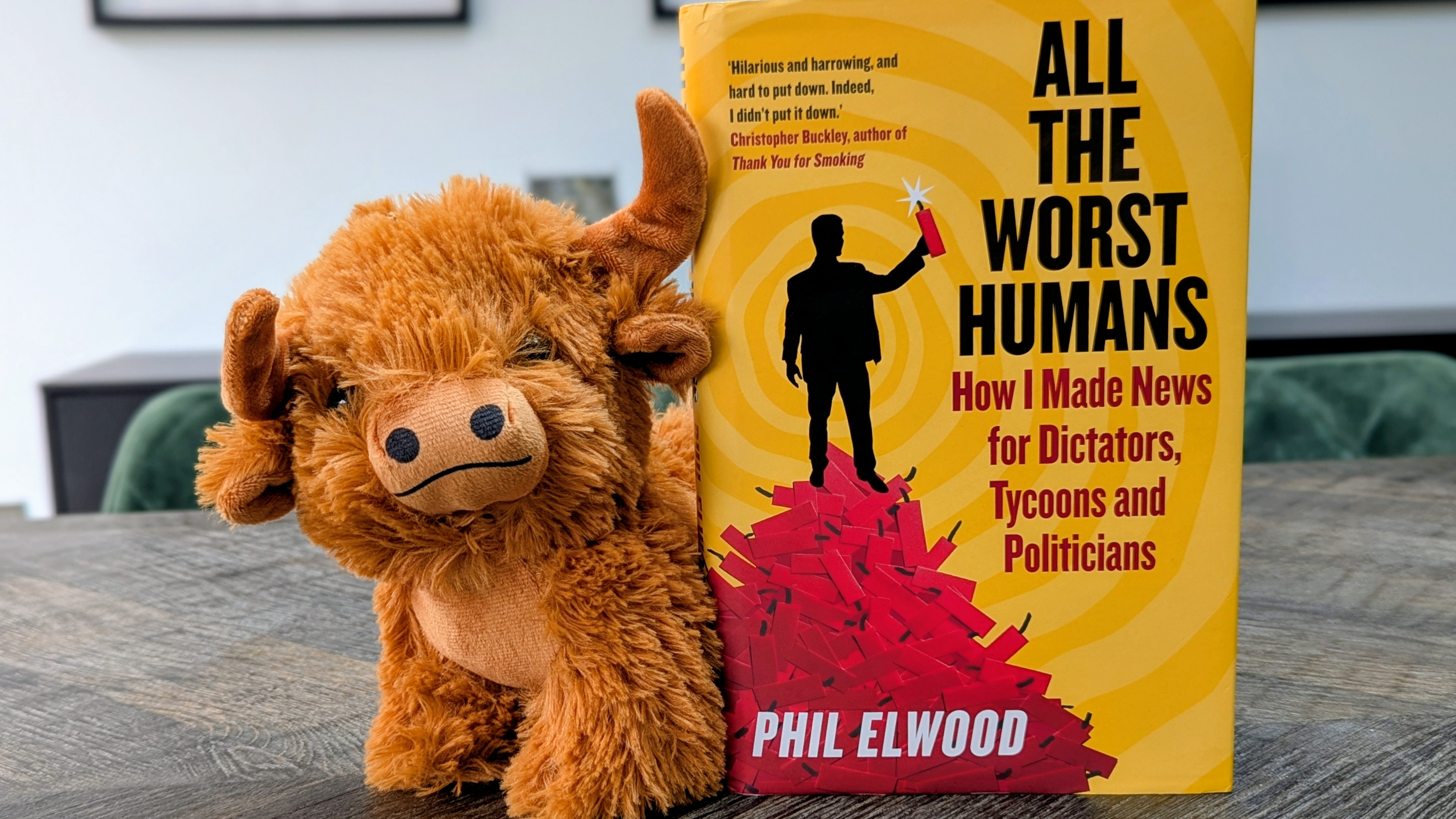
If you’re looking for a book to remind you how dull your job is, this is the one. Fascinating and depressing in equal parts.
Elwood has had quite the career in public relations (PR) and his book documents the life of somebody who’s seen and done the very worst the industry has to offer.
This book did three things for me. It taught me something about how PR works, it reinforced preconceptions I had about PR, and it told a good human story about a man navigating work and relationships while struggling with his own demons and mental health. I’ll park the mental health commentary here – that’s too serious to flippantly poke fun at in a review. If you’re struggling with your own mental health, help is available (international).
Here are some things I learnt:
Good PR is about creating narratives with archetypes. Elwood says PR people simplify complex events into emotionally compelling stories. The best PR pros are masterful storytellers.
“Every story has three parts: a villain, a victim, and a vindicator. […] In the PR business, we try to convert a villain into a vindicator or a victim as fast as possible.”
The big PR trick is to use mainstream media as the real persuasion engine. One of Elwood’s central arguments is that PR professionals don’t persuade the public directly – they persuade journalists and editors.
“My job isn’t to manipulate public opinion. My job is to get gatekeepers like CNN to do it for me.” […] Once you have ink, your story becomes real.”
This is one of the book’s major themes: legitimacy comes from media amplification, not necessarily the truth. Sigh.
Elwood repeatedly says the most valuable PR outcome is not advertising or op-eds, but getting journalists to repeat your framing independently.
“The goal of PR, the brass ring, is to get ‘earned media,’ to get a reporter to say the right thing about you.”
He contrasts this with self-published messaging because audiences trust journalists more than direct corporate communication. This leads to the saddest revelation in the book; independent journalism isn’t free from malicious influence.
He portrays the press-PR relationship as symbiotic and transactional.
“The best journalists in the world aren’t always breaking stories because of their dogged reporting skills; they’re breaking them because they rely on people like me to feed them exclusive scoops. We use our journalists to do our clients’ bidding. And then the public reads their stories and believes them because they are coming from a trusted news source and not a corporate bagman”
This depresses me. As somebody who tries to think critically about the information I’m consuming, this idea really drove home the fragility of independent journalism. Further on:
“Sadly, we have the journalists outnumbered. Three hundred thousand people are employed by the PR industry in the United States, compared to an estimated forty thousand journalists. There are seven and a half PR pros for every journalist. Would you take those odds in a fight? We also have journalists outgunned. The average salary for a PR professional is a multiple of what a journalist of comparable experience can make.”
Depressing, isn’t it? Perhaps British media is less corruptible than that of the US, whose media has gained international notoriety, but I wouldn’t bet my house on it.
Another thing. There’s this thing called ‘Astroturfing’; basically faking grassroots campaigns. One of the most controversial examples in the book involves Qatar’s World Cup bid. According to Elwood, operatives created a fake grassroots campaign to undermine the US bid. A shell non-profit was used to create the appearance of authentic public opposition. He then used this shell, The Healthy Kids Coalition, to put pressure on the US campaign bid by claiming it was a waste of US money when so many kids in the US needed the help.
Also, PR is often about reframing crises rather than solving them. A recurring theme is that PR often substitutes communication for accountability.
“If my client lights their house on fire, you can be damn sure I’ll get the press to blame outdated fire codes.”
It’s often about redirecting blame rather than addressing wrongdoing. And, if the bomb must go off, better it were controlled.
Detonating a bomb in a safe location is a PR trick of last resort. If you know you are about to be punched in the face, would you rather have Mike Tyson do it or some guy named “Mike” from accounting?
He’s talking about how stories break. If a negative story is going to drop, better to leak it to a ‘tier-two’ publication before the ‘tier-ones’ catch up.
Finally, Elwood summarises neatly, with explanations, some golden rules of PR. These are the soundbites I’ll be referencing in future when talking about a PR response.
- Don’t believe the lie that “any press is good press”
- Don’t repeat the negative
- Never wrestle with a pig in shit
- Don’t kick someone when they are up
So, I finished this book feeling pretty bewildered and disillusioned. No company conducting itself ethically and responsibly should need PR at all, right? Well, turns out that another shitty tactic of theirs is to exploit weak points and conduct reputational attacks against whoever the PR firm is trying to bring down.
So, even if you’re doing everything right, you still might need to engage PR to defend and deflect against all the bad PR you’re under attack from. It’s a perpetual loop of deceit and devilry.
There is a single glimmer of hope.
“Ninety percent of mega PR firms’ staff are bureaucrats. These firms claim to be experts in media relations, adept at securing coverage. Most of them don’t acheive results for their clients. They don’t know how to start fires. They understand their job is to create paper. PowerPoint presentations. Spreadsheets. Revise website copy.
So not everyone in PR is morally bankrupt. Most of them are just useless.
That’s reassuring.
Book club model: Yusuf