The powerful love power for its own sake, but they cloak their lust with theories that justify it.
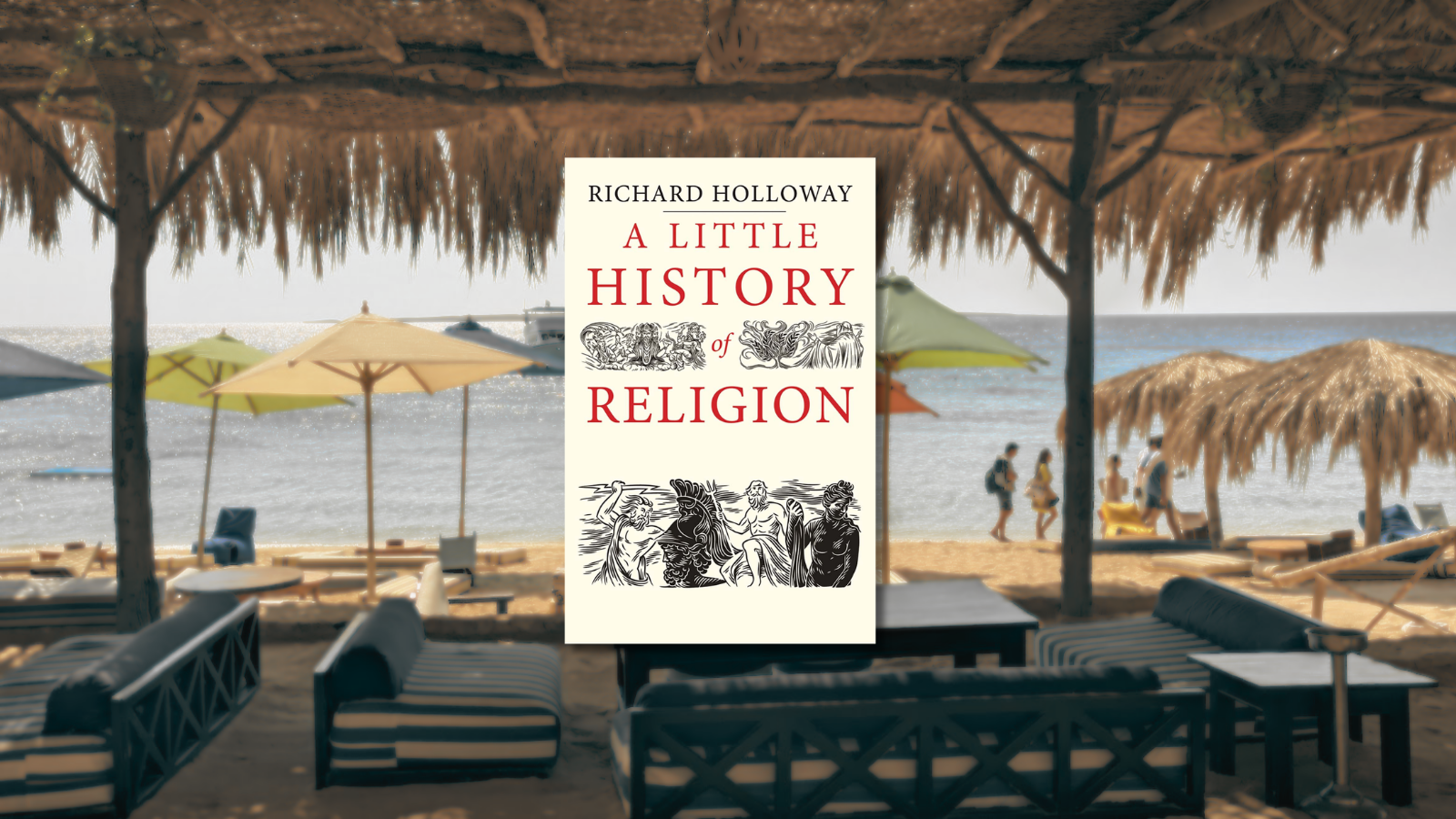
A Little History of Religion was never meant to be my holiday read, but one chapter into The Nazi Mind by Laurence Rees, I realised I’d picked the wrong book to be reading by the pool. So I parked Nazism, genocide and conspiracies for something a little lighter – religion.
I’m glad I revisited this book with a different world view. I initially read it on release ten years ago. I was less wise and more angry in my twenties, and religion was one of those topics I’d immediately go on the attack on. For the record, I’m still unwise and angry. I’m just better at channelling it into something vaguely more constructive. Or Reddit.
I appreciate Richard Holloway writing this book. A bishop-turned-agnostic with strong faith in humanity. He gives a clear and simple history of religion while adding thought-provoking commentary and critical analysis. He doesn’t pull his punches, but he builds up to the knockout moment so eloquently that you’re happy to take a haymaker to the face, metaphorically.
There are two main messages in his book (I think). The first is that shitty humans (my words, not his) use religion to justify doing shitty things (still my words).
And the best supplier of reasons for keeping people in their place has always been religion. We saw it work in the debate over slavery. The Bible and the Koran both took slavery for granted. They took the subordination of women for granted, too. So we run up against the awkward fact that sacred texts can be used to supply ammunition for those who want to keep people under control.
The second message is that religion is probably all bollocks, and that’s OK.
Let me explain.
While Holloway clearly has an ‘after-religionist’ view of religion, he also reminded me not to get angry with faith. You can’t fight faith with fact, nor should you try. Nor, more importantly, should having faith be considered a real problem. We can still find lessons and wisdom in texts we know not to be true. I mean, Christ, half of my moral grounding comes from Terry Pratchett’s Discworld series.
Modern science did religion a favour by helping it to understand itself better and change the way it talked about itself.
No, faith is not the enemy. Religious fundamentalism is the enemy. Closed-minded people who cannot change their world view in the presence of reasonable criticism and new discoveries, and who still propagate harmful views and practices in God’s name. So, while my days of attacking faith are over, I will never stop championing the cardinal importance of critical thinking. It really should be taught in schools as a core subject. Critical thinking is the only tool one can use to think one’s own way out of doing something really, really shitty.
Then there’s that other age-old question – would the world be a better place without religion? I had a very black-and-white view on this once. In fact, my view has been both black and white at various points in my life. But Holloway expresses the truth about the grey bit in the middle far better than I ever could:
But if we are all God’s children, why does God spend so much time in history ordering one branch of his universal family to wipe out another branch? Why did his love for his Jewish children have to be expressed by the extermination of his Palestinian children? Why did he later abandon his Jewish children in favour of his Christian children and encourage his new favourites to torment their older siblings? Why did he order his Muslim children who worship him as One to persecute his pagan children who worship him as Many? Why is there so much violence in religious history, all done by groups who claim God is on their side?
Unless you are prepared to believe that God actually plays favourites like some kind of demented tyrant, then there are only two ways out of this dilemma. The obvious one is to decide that there is no God. What is called God is a human invention used, among other things, to justify humankind’s love of violence and hatred of strangers. Getting rid of God won’t solve the problem of human violence but it will remove one of its pretexts.
But if you don’t want to abandon god, then you have to do some hard thinking. You have to ask yourself, what is more likely: that god is the sort of homicidal maniac religion often makes him out to be, or that religion has got god wrong, and confuses its own cruelty with his will?
Holloway also left me with some lasting thoughts to mull over. As religion continues to diminish over the twenty-first century, how do we hold on to the good bits? And there are some good bits. Many would consider marriage, for instance, a good thing. A sense of community (real community, not Facebook), another. Or even getting together and singing songs or hearing sermons. There’s nothing necessarily preventing us from these things, but I’d argue there’s nothing really compelling us to keep them either. The wrath of God is a much more effective way of bringing people together than because it’s nice.
At the end, he mentions a movement called secular humanism, something I hadn’t heard of before. Maybe that’s the answer? FFS that’s another tenner gone on World of Books, then.
Going for an angry swim.