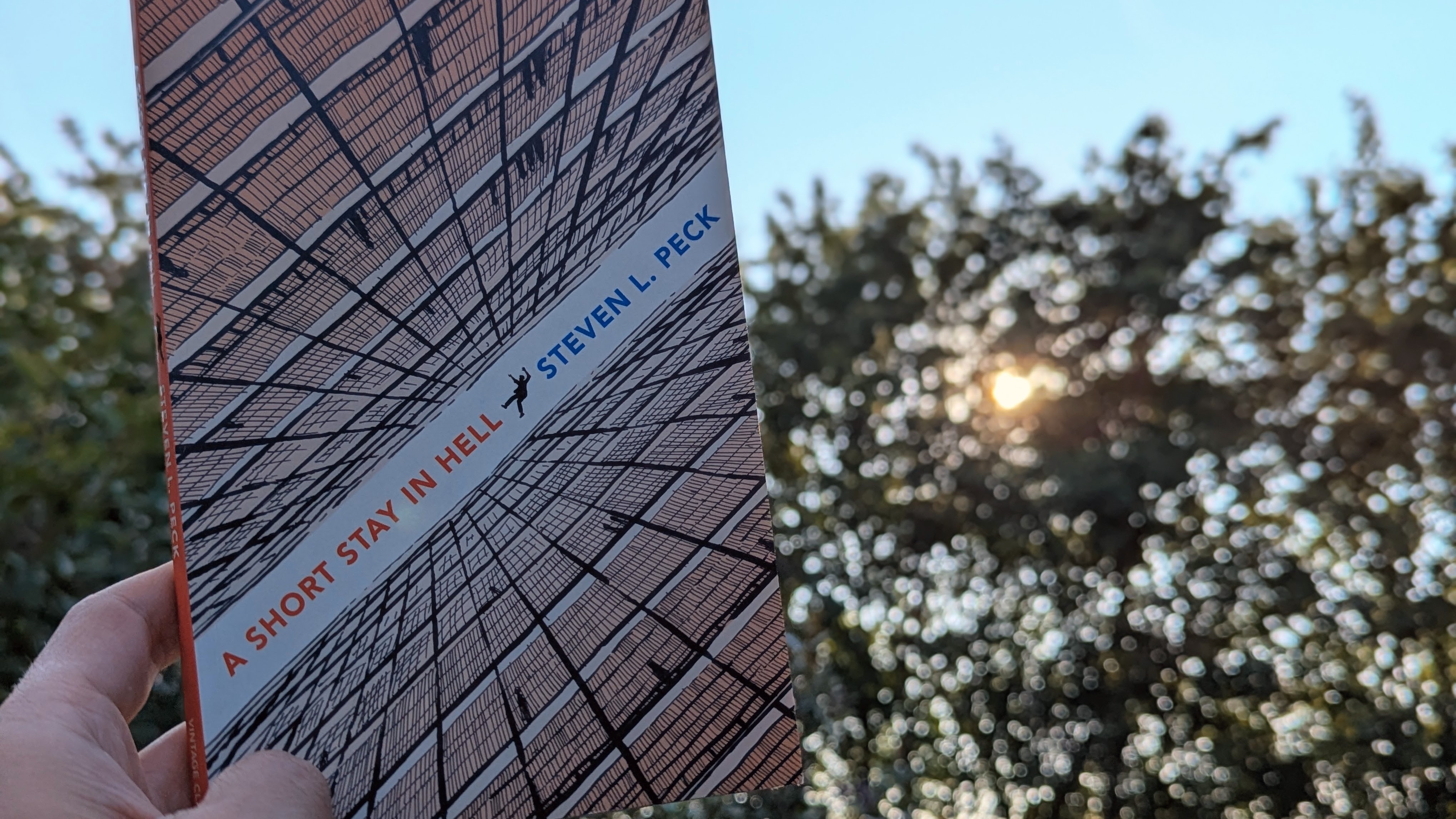
Where do all the things you believed go, when all the supporting structure is found to be a myth? How do you know how or on what to take a moral stand, how do you behave when it turns out there are no cosmic rules, no categorical imperatives?
A Short Stay in Hell is, ultimately, a book about meaning
I’m writing these thoughts moments after finishing the final page. God’s honest truth; I’ve just opened my laptop to begin writing and the time staring back at me on the login screen is 12:34.
1234 – I couldn’t believe it. Of the 1,440 possible combinations the clock cycles through each day, I happen to open my laptop on this little nugget! I should start a religion or something.
I know I’m not the only person who gets excited at finding patterns on the clock, but today it has extra special meaning. That’s because the dominant theme of A Short Stay in Hell is, in my opinion, finding meaning amidst ‘unrelenting uniformity’.
It’s a tiny book – you’ll complete it on a lazy Sunday afternoon – but it had me spending almost as much time thinking with the book in my lap, than reading its contents. It had me thinking about the meaning of relationships, about the meaning of religion, about the meaning of hope.
But above all, I thought about meaning itself. About being grateful that we can find meaning in the most mundane of things. And about how personal meaning can be. And how delicate it is. I also thought about how futile meaning is if it can be so easily lost or broken with just words and thoughts. And I thought about how important it is. It is of cardinal importance that we find meaning and enjoy it while it lasts.
A Short Stay in Hell broke my brain a bit
There are some insanely big numbers to handle.
Let me take a brief, but relevant, diversion. As a casual chess player, I’ve come across the Shannon Number before; it represents the number of possible games of chess there could be (within certain bounds). It’s a mind-bogglingly big number (10120) and demonstrates the impracticality of solving chess by brute force. For context, it is estimated that there are only (only, ha!) 1080 atoms in the observable universe. These two numbers are 40 orders of magnitude apart, but both are way too big to wrap my tiny little brain around.
Back to A Short Stay in Hell, then.
The protagonist, a Mormon geologist, finds himself ‘cast by a God he’s never heard of into a Hell whose dimensions he can barely grasp’ (I’m quoting from the back blurb here to avoid spoilers.) He has one job; to find his life story amidst the shelves of seemingly endless books. I don’t have the words, nobody does, to describe the number of books he has to sift through, one by one, to get there. But it’s far, far bigger than the Shannon number. If you think you’ve got a grasp on that number, Peck’s descriptions in the book remind you that you haven’t.
This book eased my reader’s guilt
The library in Hell contains every book that can ever be written, which includes, mostly, books made up entirely of gibberish. But when almost every book you pick up is an indecipherable load of tosh, they all ironically become the same; meaningless. To find even one book with a string of characters barely resembling language would take an age and drive a man insane.
This actually sent me down a pleasant line of thought.
I’ve always felt guilty for giving up on a book that I’m not enjoying. How can I truly make my mind up on a story if I haven’t finished it? Or have a valid opinion on why I didn’t?
But, when I really think about it, there are already more ‘real’ books in print than I will ever read in my lifetime, and we’re still not even registering on the number of books in this novella. Why would I waste time finishing a book on the chance I’ll enjoy it by the end? That just delays me picking up the next book, one that I might find great joy in reading from page one, and shortens the total number of books I’ll experience overall in my ever-ticking lifetime. To call a book I’m not enjoying ‘meaningless’ would be a bit harsh, but if I’m not seeing the personal value to me, I’m more content to put it down.
I hereby declare, from this day forth, to no longer feel bad about not finishing a book.
Life is just too short.
My one gripe; I wish it was slightly longer
I do love a short story – my attention span isn’t what it used to be – but I do wish A Short Stay in Hell was a smidgen longer. There are some loose ends I’d love to see tied up; some characters I’d like to follow further; and some happenings I’d like to see delved into in more detail.
But, alas, A Short Stay in Hell is not that kind of book. I suppose it would be impossible to wrap up one story without inadvertently opening up the next. Those ends are meant to be loose. The point, for all its brevity, is still well made.
There’s far more to say…
There’s a lot more I could say. I could describe how gutted it made me feel at times. And angry at how naïve people can be. Peaceful at times, too. And hopeless. Or I could go into detail about some of the loopholes I’ve concocted to outsmart Hell itself.
But the book is so short I’d be giving too much away by highlighting what triggered these feelings in any depth. So instead, I’ll say this.
A Short Stay in Hell is a little pocket rocket that got me thinking and feeling far more than I anticipated. At times, it stretched my feeble brain to breaking point. But I put the book down with a higher sense of gratitude and perspective. I’m tremendously glad this book crossed my path through a chance glance at a relative’s open tome – to that person, thank you!
I would recommend to anybody looking for an afternoon melon twist. It’s a book I’ll surely be discussing for a while.