
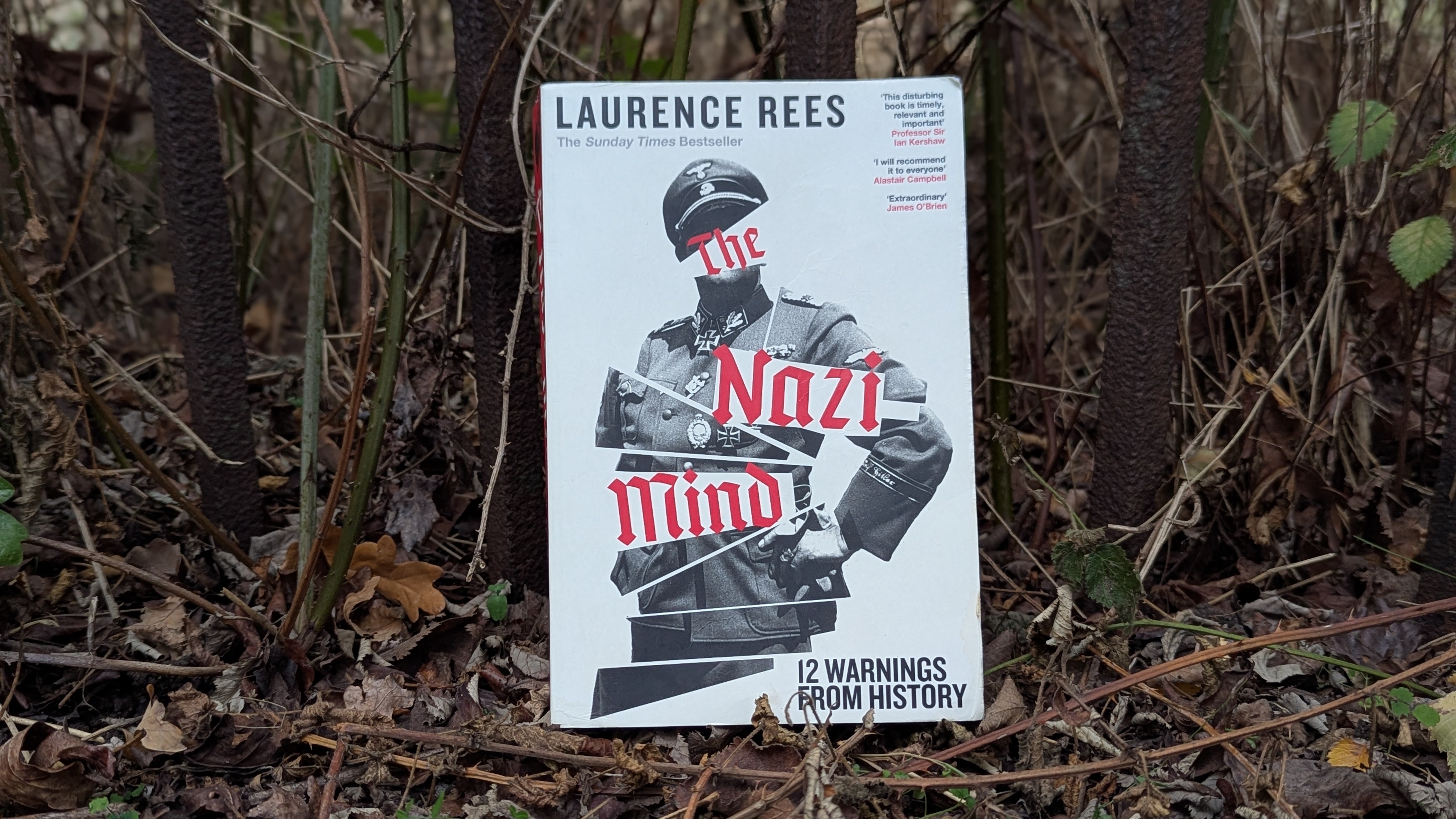
I’ll put it out there now; The Nazi Mind is probably the most important book I’ll read this year. Regardless of the final league table result, it’s certainly left a profound impression.
My enthusiasm for the Second World War stems from a healthy childhood of chasing people around the street with stick Lee Enfield rifles and hosepipe Panzerschrecks. It comes from stories that our grandparents would tell and a myriad of documentaries, films and books.
Then there’s tanks. It’s mandatory for all young boys to enjoy tanks, and the Second World War was a golden age of tank warfare.
But then you grow up, and the reality what happened starts to feel more real and very bleak. The unspeakable suffering, dehumanisation and death in numbers that become impossible to process emotionally. I don’t have the words in my vocabulary to describe what people went through – war sounds absolutely fucking shite – that’s the best I’ve got.
So I follow The Second World War today more respectfully and out of a morbid curiosity. Don’t get me wrong, I still love tanks, but every time I push them around the dining table in Memoir ’44, I’m far more aware of the little hypothetical people I’m sending forward in their tiny steel coffins.
Then a book like The Nazi Mind gets published, and I’m all for it.
Warnings, not lessons
The Nazi Mind focuses away from the battlefield to examine how the hell the world found itself in this godawful situation. It looks at the early days and rise of the Nazi party and how a small group of fringe radicals managed to accrue so much power and influence over the German people.
I’m trying to avoid the temptation of pointing at today’s fringe politicians and marking the similarities. Rees shows enough restraint to not do this in his book, so I shouldn’t either. He makes clear very up front that these are 12 warnings, not lessons. It’s easy to point the finger and say “Hitler did that, so you’re as bad as Hitler.” But the similarities are certainly there. And so are the warnings.
Every chapter is superbly written, argued and articulated. He makes a convincing case on how the Nazis exploited social behaviours, evolution and biology – among other things – to accrue the power that they would eventually have. I’m going to be looking out for more from Rees – but I did find some of his analysis easier to tie to the warning message than others.
Spreading conspiracy theories, for example, made a clear argument about how the Nazis presented some of Germany’s problems as the result of deliberate plots by Germany’s enemies – Jews and Marxists, mostly. This makes sense and, looking at the relationship between today’s anti-vaccine movement and election rigging, I completely see how targeting a group of people with limited critical thinking skills can really help your conspiracy theory take off.
If someone believes one conspiracy theory, they are more likely to believe in or look for others. People can go down the rabbit hole, and you can get a bit lost.
But then there’s a warning like conniving with the elite, which makes a valid point, but shoehorns a lot of other stories into the chapter which don’t completely reinforce it, in my humble opinion. Excellent stories, might I add, but not sure there’s an entire chapter here.
Marketers: Are we… the baddies?
This book can be dark and miserable in places – expect nothing less from this topic. But the scariest bit for me was something that had me questioning my own virtues.
You see, some of this stuff – these so-called warnings that gave some of the most evil people in history the platform to commit such unthinkable acts – is actually marketing best practice.
Let me explain.
In the Using Them and Us chapter, Rees explains how the Nazis divided society into a supposedly superior us and a dangerous inferior them. This was all bollocks, obviously, but by creating a sense of unity among one group of people (e.g. the Volksgemeinschaft), the Nazis encouraged these same people to define themselves through opposition to other groups such as Jews, Roma or people with disabilities.
Now let’s quickly skip over to another book – Influence by Robert Cialdini – a must-read for marketers everywhere. He’s got a chapter called Unity. Unity is about creating a sense of shared identity and belonging. Unity can come from shared values, beliefs, culture, experiences, struggles, causes or anything else. The point is, if you can create a sense of unity among your target market, you can sell them anything that makes them feel part of something they want to be associated with. It’s why Apple makes their customers feel like they’re the trendy, creative ones by buying an iPhone and why GoPro makes theirs feel like they’re society’s adventurers by buying a camera.
Notice any similarities? Obviously, one group is selling overpriced Chinese-made fashion gadgets and the other is selling hate, bigotry and evil – but the tactics are identical.
Another technique in Influence is called the commitment and consistency principle. You see, when you take a step in one direction, your brain creates a psychological sunk cost. Taking another step forward feels more natural and efficient than backing out. That’s why we (marketers, not Nazis) try to make you take lots of little steps rather than one big one. How many times have you been completing a survey and by the fifth page, the number of questions has quadrupled, but you keep going anyway because the bar say’s you’re 80% complete? That’s commitment and consistency, my friend.
Turns out the Nazis knew this, too. They turned the dial of their agenda up so slowly so that society never felt like the next step was much further away than where they had previously been.
Obviously, it would be perverse to draw equivalence between marketing & comms professionals and the atrocities that happened in the early 20th-century. Of course we’re not the baddies. But what’s scary is the similarity in the methods used to work people’s psychological buttons. With great power, comes great responsibility, I guess.
The verdict
The Nazi Mind is excellent; it got me thinking a lot, and I’d recommend it to anybody with an interest in the second world war, politics, history, psychology and even… marketing and comms.
It’s utterly miserable at times, but its absolutely essential.
No tanks, though. Sadly.


