
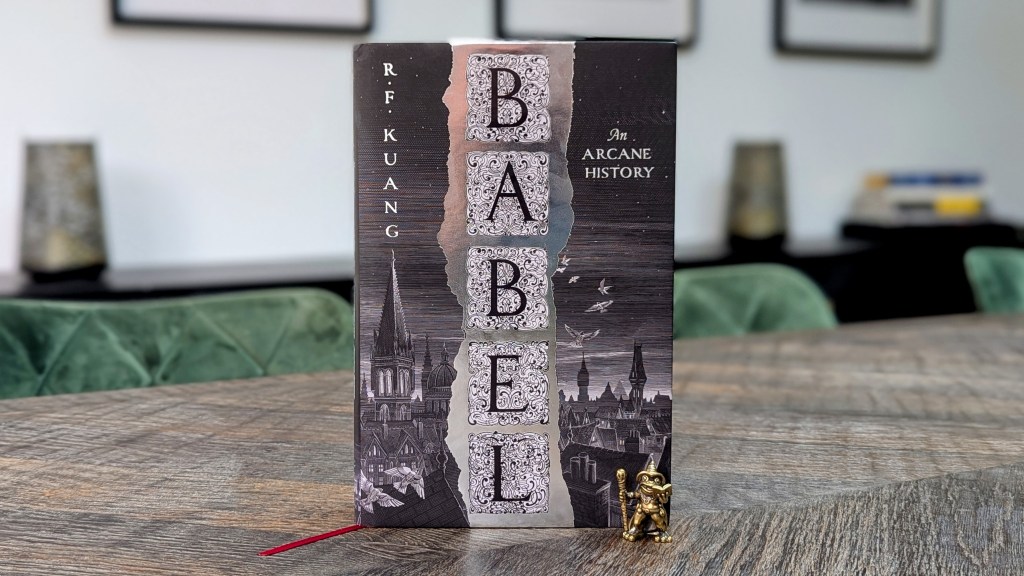
What a book!
Last year I went down a rabbit hole buying books about languages; language history; word etymology; that sort of thing. I then came across this book in, of all places, TK Maxx! This impulse buy has turned out to be one of the best pieces of fiction I’ve read in the last ten years.
If low fantasy isn’t your thing, I’d struggle to sell this to you. But if the idea of magic conjuring itself into being through words and – uniquely for my reading history – their shared linguistic roots, then you’re in for a treat. In an oversaturated fantasy landscape, Kuang has created a unique premise, and executed it brilliantly.
The story follows Robin Swift, a Chinese orphan brought to England to study at Oxford’s Royal Institute of Translation (Babel), where he becomes increasingly aware that the institution’s scholarship and magic are inseparable from colonial exploitation and imperial violence. As Robin and his friends confront racism, class inequality, and the moral cost of empire, the novel evolves from a dark academia story into a political and revolutionary one, exploring how language shapes power, identity, and resistance.
If following a bunch of students studying magic rings alarm bells, fear not. Think more Jonathon Strange and Mr Norrell than Harry Potter in tone.
There’s another, more personal reason this book resonated with me. As somebody who works closely with translation professionals in a global marketing organisation, this book helps articulate the problem with a centralised, English-first mindset and content strategy. A core truth of localisation is that translation is never perfectly neutral or exact. Here’s a good quote:
Consider how tricky it is merely to say the word hello. Hello seems so easy! Bonjour. Ciao. Hallo. And on and on. But then say we are translating from Italian into English. In Italian, ciao can be used upon greeting or upon parting – it does not specify either, it simply marks the etiquette at the point of contact. It is derived from the Venetian s-ciao vostro, meaning something akin to “your obedient servant”. But I digress. The point is, when we bring ciao into English – if we are translating a scene where the characters disperse, for example – we must impose that ciao has been said as goodbye. Sometimes this is obvious from context, but sometimes not – sometimes we must add new words in our translation. So already things are complicated, and we haven’t moved past hello.
Babel shows how even small shifts in wording, cultural context, or implied meaning can create entirely different emotional and political effects. Effective translation requires interpretation, cultural sensitivity, and strategic intent. Not just word substitution. Which brings me nicely to the second bugbear I have at work – machine translation. It’s great for the quick-and-dirty. It’s cheap. It’s also a middle finger to anybody with a respect of words. Another quote:
‘Language does not exist as a nomenclature for a set of universal concepts,’ Professor Playfair went on. ‘If it did, then translation would not be a highly skilled profession – we would simply sit a class full of dewy-eyed freshers down with dictionaries and have the completed works of the Buddha on our shelves in no time. Instead, we have to learn to dance between that age-old dichotomy, helpfully elucidated by Cicero and Hieronymous: verbum e verbo and sensum e sensu.’
[…]
‘The words schlect and schlimm both mean “bad” in German, but how do you know when to use one or the other? When do we use fleuve or rivière in French? How do we render the French esprit into English? We ought not merely translate each word on its own, but must rather evoke the sense of how they fit the whole passage.’
[…]
‘translators do not much deliver a message as they rewrite the original. And herein lies the difficulty – rewriting is still writing, and writing always reflects the author’s ideology and biases. After all, the Latin translatio means “to carry accross”. Translation involves a spacial dimension – a literal transportation of texts across conquered territory, words delivered like spices from an alien land. Words mean something quite different when they journey from the palaces of Rome to the tearooms of today’s Britain’
I have yet to see machine translation get either verbum e verbo or sensum e sensu right without human intervention.
Finally, I appreciate this book because it had me exploring a ton of new material. Chapters often start with an epigraph, and the whole work is littered with literary references. I found myself putting the book down constantly to look up passages, poets or authors, and would lose hours immersed in frenzied research.
So there you have it; a great story; a lesson on language; and an excuse to sound more clever at work. The holy trinity of why I read. And not only has this book restored my faith in fantasy fiction, it’s also restored my faith in TK Maxx. Slam dunk.
Book club model: Wizard-frog

 Glyphs & Graphs