
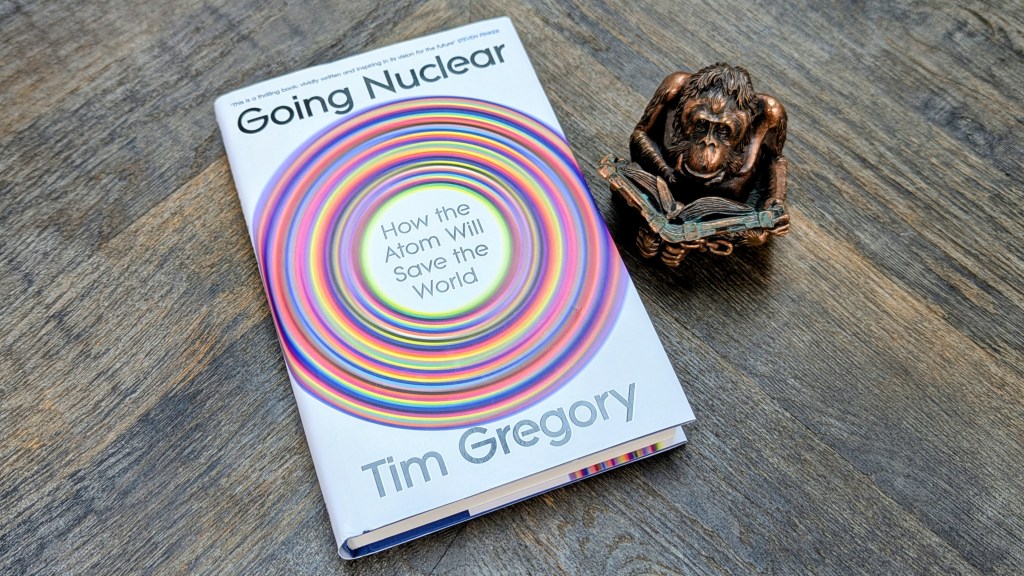
What an excellent book!
I first came across Tim Gregory when he appeared on James O’Brien’s LBC show. I remember thinking there’s a guy who loves what he does. His energy and enthusiasm for nuclear power comes across in spades in the book, too, which is crucial for breaking down an otherwise complicated and niche topic.
Gregory, via this book, has me convinced on a number of things:
- Nuclear is vital to solving the climate crisis. As industry becomes more electrified, including the proliferation of AI data centres, generating enormous amounts of low-carbon energy at scale is a necessity.
- Nuclear power is uniquely powerful and energy-dense. tiny amounts of uranium can produce huge quantities of electricity with minimal fuel and land use. He presents nuclear as a highly efficient, concentrated energy source compared with diffuse renewables.
- Renewables alone are not enough. Modern societies need steady “firm power” when weather conditions are poor. Fossil fuels often fill the gap when renewables underperform. This learning surprised me the most. The UK is a world leader in renewable energy through wind, but overreliance on wind actually guarantees our reliance on gas! When the wind stops blowing, the gas stations get fired up.*
- Public fear of radiation is exaggerated. People are irrationally afraid of flying, even though driving presents a much greater danger. It’s the same with nuclear. Air pollution from fossil fuels will get you much more effectively than your odds of a nuclear catastrophe. When nuclear disasters do occur (Chernobyl, Fukushima Daiichi, Three Mile Island), death tolls and environmental impacts are often overstated relative to the ongoing harms of fossil fuels.
- Nuclear waste is manageable. Nuclear waste is a technical and political challenge, not an unsolvable one.
- Nuclear science has benefits beyond electricity. Possibilities for nuclear extend far beyond power generation into areas like nuclear medicine, industrial uses, forensics, food irradiation, and even space exploration.
The only criticism I have of the book is actually what got me reading the book in the first place – Gregory’s optimism and energy. Gregory is an excellent PR guy – his job is to make me believe in nuclear.
Nevertheless, I am convinced nuclear is the way forward for Britain’s energy future. Renewables are only part of the solution, but guarantee reliance on fossil fuels. Solar and wind are unreliable, dams destroy ecosystems and battery storage is too expensive, raises mining and manufacturing concerns and only short-term reliable.
I’ll be looking at who’s talking about nuclear in the next UK general election, for sure.
*If you want to see this for yourself, check out this excellent live data dashboard of the UK National Grid created by Kate Morley. You see fossil fuel energy increase to compensate for the lack of supply when wind and solar drop.
Book club model: The Librarian

 Glyphs & Graphs