
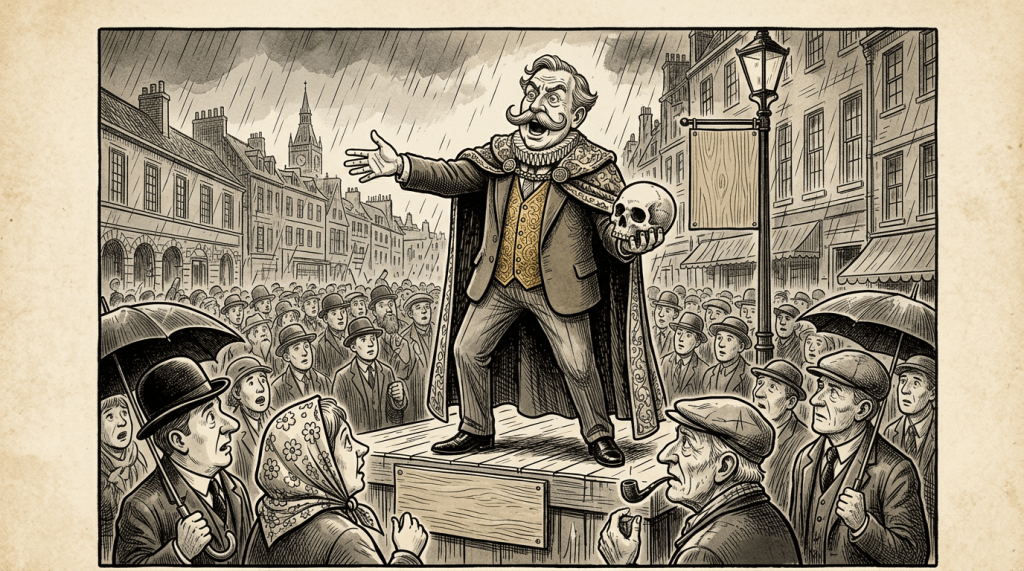
I’ve recently been reading about logical fallacies, and thought it would be a good demonstrative exercise to summarise them through a series of… ehem… hypothetical political examples. Do keep an eye out for these traps in real life!
Bingo card coming shortly…
Ad hominem / to the man
Attacks the person rather than the argument they are making.
Of course he criticises our party, he is part of the political elite
This example dismisses the argument based on who said it.
Affirming the consequent
Assuming that because the consequent is true, the antecedent must also be true.
If immigration harms the economy, wages fall. Wages have fallen and therefore immigration must be harming the economy
This example ignores other causes and assumes this one thing is the driver.
Appeal to fear
Playing on people’s fear by imagining a scary future that would be of their making if the appealer’s argument is opposed.
If you don’t vote for our party then crime, immigration and economic decline will spiral out of control
Rather than provide evidence, these kind of arguments rely on rhetoric, threats or outright lies.
Appeal to hypocrisy
Countering somebody’s argument by pointing out that if conflicts with his or her own past actions or statements.
You criticise our party, but the party you support has flaws too
By answering a charge with a charge, it doesn’t address the criticism itself.
Appeal to ignorance
Assumes an argument is true because there is no evidence of proving it false.
High levels of immigration reduce social cohesion, because there is no evidence that it doesn’t
You cannot prove a negative. To quote Carl Sagan, “absence of evidence is not evidence of absence.”
Appeal to the bandwagon
Assumes that because many people believe something, it must be true
More and more people oppose net zero targets, the right thing to do is scrap them
The popularity of a policy does not equal correctness or what’s best for people by specific measures.
Appeal to irrelevant authority
Arguments that appeal to authorities that have no credentials in the topic are often fallacies.
Our immigration policies have the endorsement of a numerous high-profile celebrities
The authority could be a person, group of people or even something intangible like ancient wisdom.
Argument from consequences
Speaking for or against the truth of a statement based on the consequences it would have if true/false.
Our party policies must be correct, because if they weren’t, the country would face serious economic and cultural decline
This kind of argument plays on people’s hopes and fears rather than logic. There is some crossover here with red herrings, appeals to fear and slippery slopes.
Circular reasoning
Where one assumes the conclusion in one of the premisses.
Our party is right, because our policies are right
There is no independent justification of the argument.
Composition and division
Inferring that, because the parts of a whole have a particular attribute, the whole must have that attribute also.
Our party cannot be racist, because some of our members are from ethnic minorities
This example does not guarantee that all policies do not discriminate against ethnic minorities.
Equivocation
Exploits the ambiguity of language by changing the meaning of a word during the course of an argument.
We need to take back control, and our party gives us control
The term control here is vague and shifts meaning, as is the use of we and us.
False cause / not a cause for cause
An argument that assumes a cause for an event when there is no evidence one exists.
Since immigration has increased, we’ve seen a rising pressure on housing and public services. Immigration is the problem.
This argument implies that one thing caused the other, without demonstrating if /how much there was cause/correlation.
False dilemma
An argument that presents a limited set of possibilities (usually two) and assumes that everything in scope of the conversation falls under one of them.
Either you support our party or you support uncontrolled immigration
This argument ignores the middle-ground policies and parties.
Genetic fallacy
When an argument is either devalued or defended solely because of its origins.
That policy comes from the EU, therefore it cannot be trusted
The origin of the policy does not dictate the credibility of the policy.
Guilt by association
Used to discredit an argument for proposing an idea that is shared by some socially demonised individual or group
Opposing our party puts you on the same side as the politicians who are corrupt
This example attempts to discredit via association.
Hasty generalisation
When one forms a conclusion that based on either too small or too niche of a sample to be representative. A broad conclusion from limited evidence.
I saw a case of benefit fraud involving migrants in the news. The system is therefore being wildly abused
This example relies on an emotional reaction rather than well-sampled and representative data.
No true Scotsman
When somebody defends a claim about a group of things by arbitrarily redefining criteria for membership of that group.
You call yourself a patriot, but no true patriot would support any other party
This example changes to the definition of patriot to protect the idea that there is only one party for true patriots.
Slippery slope
Discredit a proposition by arguing that it will lead to a sequence of events which are undesirable.
If we don’t drastically reduce immigration, the country will completely lose its culture within a generation
This example assumes a chain of events without evidence.
Straw man
To intentionally caricature a person’s argument with the aim of attacking the caricature rather than the argument.
People who oppose us just want completely open borders and no immigration controls at all
This example exaggerates the opposing view by creating a straw man. The opposing view can, and often is, more nuanced.

 Glyphs & Graphs